{ "@context": "https://schema.org", "@type": ["WebPage", "FAQPage"], "@id": "https://www.bimoutsourcing.co.uk/faq#webpage", "name": "FAQ – BIM Outsourcing", "description": "Frequently asked questions about BIM, MEP BIM modelling, BIM levels, LOD, COBie, IFC, BIM execution plans, and BIM outsourcing services from BIM Outsourcing, Maidstone.", "url": "https://www.bimoutsourcing.co.uk/faq", "inLanguage": "en", "isPartOf": { "@type": "WebSite", "@id": "https://www.bimoutsourcing.co.uk/#website", "name": "BIM Outsourcing", "url": "https://www.bimoutsourcing.co.uk/" }, "publisher": { "@type": "ProfessionalService", "@id": "https://www.bimoutsourcing.co.uk/#business", "name": "BIM Outsourcing", "url": "https://www.bimoutsourcing.co.uk/", "email": "info@bimoutsourcing.co.uk", "telephone": "01622296277", "address": { "@type": "PostalAddress", "streetAddress": "Innovation Centre, Gidds Pond Way, Weavering", "addressLocality": "Maidstone", "addressRegion": "Kent", "postalCode": "ME14 5FY", "addressCountry": "GB" } }, "breadcrumb": { "@type": "BreadcrumbList", "itemListElement": [ { "@type": "ListItem", "position": 1, "name": "Home", "item": "https://www.bimoutsourcing.co.uk/" }, { "@type": "ListItem", "position": 2, "name": "FAQ", "item": "https://www.bimoutsourcing.co.uk/faq" } ] }, "mainEntity": [ { "@type": "Question", "name": "What is BIM (Building Information Modelling)?", "acceptedAnswer": { "@type": "Answer", "text": "BIM, or Building Information Modelling, is an integrated process that relies on coordinated and reliable information. It goes beyond 3D CAD, enabling the creation of coordinated digital design information and documentation. With BIM, you can predict performance, appearance, and cost, delivering projects faster, more economically, and with reduced environmental impact. It ensures a single source of truth throughout the project lifecycle and fosters collaboration through shared 3D models and structured data." } }, { "@type": "Question", "name": "Is BIM just a 3D model?", "acceptedAnswer": { "@type": "Answer", "text": "No. BIM encompasses a variety of files and components — not just a single 3D file. It includes graphical models that evolve from conceptual shapes into detailed 3D models with linked 2D elements, non-graphical data such as properties, specifications, and cost information managed in databases, and documentation such as floor plans and schedules. Together these form the comprehensive Building Information Model essential for project development and asset management." } }, { "@type": "Question", "name": "What are the primary advantages of adopting BIM?", "acceptedAnswer": { "@type": "Answer", "text": "Adopting BIM enhances collaboration among project stakeholders, improves communication and coordination, and enables better visualisation of complex design concepts. Early applications for contractors include scope clarification, clash detection and avoidance, design validation, construction sequencing, marketing presentations, options analysis, walkthroughs, and virtual mock-ups." } }, { "@type": "Question", "name": "What is meant by dimensions in BIM?", "acceptedAnswer": { "@type": "Answer", "text": "BIM deals with multiple dimensions including 2D, 3D, 4D, and 5D. Each dimension adds a unique aspect to project management and planning, enabling stakeholders to visualise, schedule, and estimate costs effectively." } }, { "@type": "Question", "name": "What does 2D signify in BIM?", "acceptedAnswer": { "@type": "Answer", "text": "In BIM, 2D refers to basic line work similar to traditional drafting. It involves creating geometric representations without depth, commonly used for floor plans, elevations, and sections." } }, { "@type": "Question", "name": "How is 3D defined within the scope of BIM?", "acceptedAnswer": { "@type": "Answer", "text": "3D in BIM represents objects with depth and attached data, allowing for detailed specifications. It enables the creation of comprehensive 3D models, facilitating visualisation and coordination among project stakeholders." } }, { "@type": "Question", "name": "What is meant by 4D in BIM methodology?", "acceptedAnswer": { "@type": "Answer", "text": "4D in BIM integrates time into the project by linking project schedules with the 3D model. This enables stakeholders to visualise the construction sequence and plan project phases more effectively." } }, { "@type": "Question", "name": "What does 5D entail in the context of BIM?", "acceptedAnswer": { "@type": "Answer", "text": "5D in BIM incorporates cost estimation into the digital model, utilising additional software for accurate cost assessment. This dimension enhances project planning by integrating cost considerations with the 3D model and schedule." } }, { "@type": "Question", "name": "What are the different levels of BIM maturity?", "acceptedAnswer": { "@type": "Answer", "text": "BIM maturity is categorised into four levels: Level 0 — organisations use unmanaged CAD systems; Level 1 — managed CAD is introduced within a Common Data Environment; Level 2 — managed CAD in a 3D environment with federated models incorporating 4D and 5D elements; Level 3 — a fully open process with integrated data enabled by IFC and IFD frameworks for collaborative model sharing." } }, { "@type": "Question", "name": "What is UK BIM Level 2?", "acceptedAnswer": { "@type": "Answer", "text": "UK BIM Level 2 involves a structured approach to BIM implementation supported by documents and standards including PAS 1192-2 for capital phase information management, PAS 1192-3 for the operational phase, BS 1192, and the BS 8541 series. It includes managed CAD in a 3D environment with federated models and data attachment incorporating 4D and 5D elements." } }, { "@type": "Question", "name": "What is openBIM and Industry Foundation Classes (IFC)?", "acceptedAnswer": { "@type": "Answer", "text": "OpenBIM facilitates collaborative design through open standards, enabling seamless information exchange between different software tools. Industry Foundation Classes (IFC) serve as an open data format ensuring comprehensive data exchange without information loss, and improving interoperability between different platforms." } }, { "@type": "Question", "name": "What are Employer's Information Requirements (EIR)?", "acceptedAnswer": { "@type": "Answer", "text": "Employer's Information Requirements (EIR) outline the specific information that the client or employer requires from a construction project, including project objectives, deliverables, standards, and expected outcomes for information management and exchange throughout the project lifecycle. The EIR acts as a roadmap for how information is managed, structured, and delivered." } }, { "@type": "Question", "name": "What are BIM Execution Plans (BEPs)?", "acceptedAnswer": { "@type": "Answer", "text": "BIM Execution Plans (BEPs) are documents prepared at the start of a project detailing the management and exchange of project information throughout its lifecycle. Divided into pre-contract and post-contract phases, BEPs outline project objectives, milestones, information delivery strategies, and responsibilities within the supply chain. They ensure alignment with Employer's Information Requirements (EIR)." } }, { "@type": "Question", "name": "What are the consequences of not using a BIM Execution Plan?", "acceptedAnswer": { "@type": "Answer", "text": "Without a BIM Execution Plan, project teams create non-reusable and non-interoperable solutions repeatedly, leading to longer delivery times, more design errors, redundant data entry, and reduced efficiency. The absence of performance insights during design can increase resource consumption and overlook functional and environmental constraints." } }, { "@type": "Question", "name": "What does LOD (Level of Development) mean in BIM?", "acceptedAnswer": { "@type": "Answer", "text": "LOD, or Level of Development, refers to the degree of detail and accuracy of a BIM model at different project stages. In the UK, LOD levels are categorised as LOD 100, 200, 300, 400, and 500, each representing increasing detail from conceptual models through to detailed models suitable for fabrication and construction." } }, { "@type": "Question", "name": "What is LOD 100 in BIM?", "acceptedAnswer": { "@type": "Answer", "text": "LOD 100 represents the conceptual design stage in BIM. It involves basic geometric representations indicating the general shape, size, and orientation of elements within the model." } }, { "@type": "Question", "name": "What does LOD 200 signify in BIM?", "acceptedAnswer": { "@type": "Answer", "text": "LOD 200 corresponds to the schematic design stage in BIM. It includes more detailed geometry with approximate quantities, sizes, shapes, and locations of elements within the model." } }, { "@type": "Question", "name": "What does LOD 300 represent in BIM?", "acceptedAnswer": { "@type": "Answer", "text": "LOD 300 represents the design development stage. It includes accurate geometry with specific quantities, sizes, shapes, and locations of elements within the model, suitable for coordination." } }, { "@type": "Question", "name": "What is LOD 400 in BIM?", "acceptedAnswer": { "@type": "Answer", "text": "LOD 400 refers to the construction stage in BIM. It includes accurate geometry along with detailed information required for fabrication and installation." } }, { "@type": "Question", "name": "What does LOD 500 mean in BIM?", "acceptedAnswer": { "@type": "Answer", "text": "LOD 500 represents the as-built stage in BIM. It reflects actual built conditions, including accurate geometry and verified information following construction." } }, { "@type": "Question", "name": "What is a Common Data Environment (CDE)?", "acceptedAnswer": { "@type": "Answer", "text": "A Common Data Environment (CDE) is a centralised digital platform where project teams manage and share project information throughout the construction lifecycle. It includes areas for work in progress, shared information, and archived data with defined processes between them. A CDE may be structured folders on an extranet or a cloud-based platform such as BIM 360." } }, { "@type": "Question", "name": "What is COBie?", "acceptedAnswer": { "@type": "Answer", "text": "COBie, or Construction Operations Building Information Exchange, is a structured method for capturing non-graphical data from a BIM model. It supports information exchange across different project stages including design, construction, and operation, enabling standardised data sharing between different software platforms." } }, { "@type": "Question", "name": "What are the benefits of BIM for the construction industry?", "acceptedAnswer": { "@type": "Answer", "text": "BIM benefits include improved collaboration, clash detection, reduced on-site errors, better visualisation, construction sequencing support, and lifecycle cost analysis. Specific advantages include supporting scoping during bidding, value engineering, trade coordination, prefabrication support, and helping clients understand projects. BIM is especially valuable for complex buildings such as hospitals, laboratories, and airports." } }, { "@type": "Question", "name": "Is it feasible to integrate BIM into ongoing construction projects?", "acceptedAnswer": { "@type": "Answer", "text": "Yes, integrating BIM into ongoing construction projects is both feasible and beneficial. While it may require adjustments to existing workflows and stakeholder collaboration, BIM can improve efficiency, coordination, and communication by digitising project information and helping teams identify and resolve issues earlier." } }, { "@type": "Question", "name": "What types of projects are most suitable for BIM implementation?", "acceptedAnswer": { "@type": "Answer", "text": "Projects involving complex designs, tight schedules, large teams, and high coordination requirements are particularly suited to BIM. Examples include infrastructure projects, commercial developments, healthcare facilities, and educational buildings." } }, { "@type": "Question", "name": "Is BIM only for large-scale projects?", "acceptedAnswer": { "@type": "Answer", "text": "No. While BIM offers clear advantages for complex developments, it is equally beneficial for small and medium-sized projects. BIM helps streamline processes, improve coordination, reduce errors, and increase efficiency regardless of project size." } }, { "@type": "Question", "name": "What are the common obstacles to adopting BIM?", "acceptedAnswer": { "@type": "Answer", "text": "Common obstacles include initial investment costs, resistance to change, lack of training and expertise, interoperability challenges between software platforms, data security concerns, and the need for standardised processes. Addressing these requires a structured approach considering both technical and organisational factors." } }, { "@type": "Question", "name": "What specific challenges might arise during BIM implementation?", "acceptedAnswer": { "@type": "Answer", "text": "Challenges during BIM implementation may include integrating new technology into existing workflows, ensuring adequate staff training, managing interoperability between platforms, maintaining data accuracy, overcoming resistance to change, and managing initial costs. These require careful planning and stakeholder involvement." } }, { "@type": "Question", "name": "What are the key factors that impact the cost of BIM modelling?", "acceptedAnswer": { "@type": "Answer", "text": "The cost of BIM modelling depends on project size, complexity, timeframe, level of detail, building type, quality standards, and coordination requirements. Pricing methods may include cost per square metre, hourly rates, or fixed pricing. BIM Outsourcing provides a pricing page and online calculator to estimate project costs at bimoutsourcing.co.uk/pricing." } }, { "@type": "Question", "name": "What are the key software tools required for BIM implementation?", "acceptedAnswer": { "@type": "Answer", "text": "For MEP services, commonly used tools include Revit MEP and AutoCAD MEP. Architectural and structural disciplines typically use Revit Architecture, Revit Structure, and Tekla Structures. Navisworks is widely used for clash detection and coordination. Collaboration platforms such as BIM 360 and Trimble Connect are used to manage and share project information." } }, { "@type": "Question", "name": "What key deliverables are associated with MEP and Fire Protection disciplines in BIM projects?", "acceptedAnswer": { "@type": "Answer", "text": "Key MEP and fire protection BIM deliverables include detailed 3D models of building services systems, equipment schedules, clash reports, coordination drawings, and construction drawings. These support accurate design, coordination, and efficient installation on site." } } ] }

FAQ

WATCH: YOUR TOP BIM QUESTIONS ANSWERED

In these two short videos, we explain the key factors behind BIM costs for both BIM modelling and BIM content creation.

Modern office workspace with dual monitors, ergonomic chair, wooden storage cabinets, large windows, and overhead track lighting.

Watch Video

MEP BIM Modelling: What Project Managers Need to Know

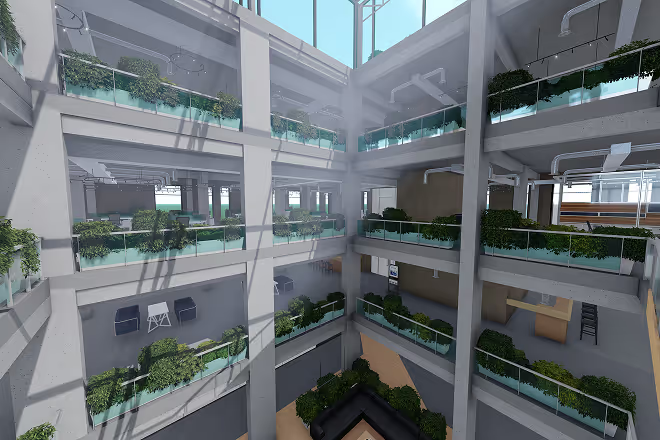
Interior view of a multi-story building with open balconies lined with glass railings and green plants, under a clear blue sky.

Watch Video

Revit Families: Key Answers for Manufacturers